
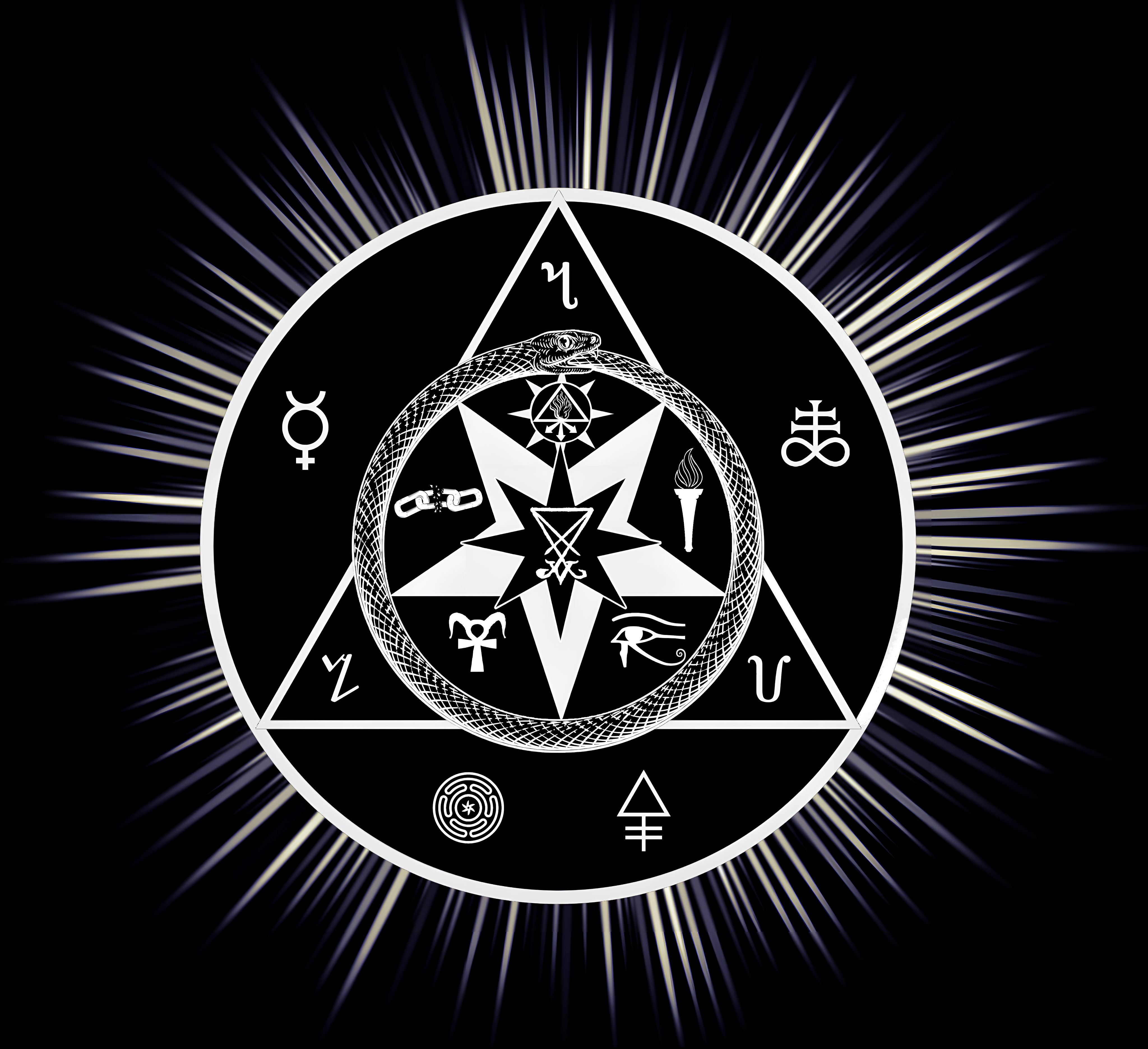
Introduction
Symbolism and The Light Bearer
Symbols may be interpreted as the language of the subconscious. One of the chief aspects of magick is understanding symbolism as a means of commanding the subconscious into conscious power. A sigil (or seal), a term derived from the Latin “Sigillum,” refers to a kind of pictorial signature of an angel, demon or spirit. Old magick books contained the seals of such entities, which represented their true names and selves as a means of invoking them (and/or their characteristics). These seals have never been intended or created as an identification symbol or manor crest, even though they are used by many as an emblem just as well as for their original intent. During a ritual, the subconscious mind can absorb the sigil and, by ritual and/or visualization, it can activate the subconscious to manifest in the actual conscious mind.
The name Lucifer is a Latin word meaning light-bearer from “Lux,” meaning light, and “Ferre” meaning “to bear.” It is a Roman term for the planet Venus, also known as the “Morning Star” and/or the “Evening Star” (before it was known that both were the same). Like so many Roman concepts, this was also of Greek origin: Lucifer is, in fact, a translation of the Septuagint Greek “Heōsphoros” (phosphorus), meaning dawnbearer, lightbearer (a name which is also the origin of the chemical element Phosphorus, thus named in the XVII century), as well as the Hebrew “Helel,” meaning “Bright one.” However, the planet Venus as the bringer of Light had been associated with other deities long before Phosphorus. Lucifer is also considered a mask of a syncretic deity composed of both masculine and feminine deities from the ancient world associated with the planet Venus. The earlier account of such a deity is Inana.
Inana was the living embodiment of the planet Venus, Goddess of Love, Sex and War, Kingship and Dominion, Divine Justice, associated with the eight-pointed star (Venus) and Lions (a symbol of power). Transgressive in nature, Inana was later made famous in the epic poem of her descent into the Underworld and back (https://etcsl.orinst.ox.ac.uk/section1/tr141.htm), having sat at her sister’s Ereškigal (ruler of the Underworld) throne while being there. Few know that this journey was a plan to rule over all dominions, “Heaven”, “Earth” and the “Underworld” itself. When she started the journey, she had already stolen “Heaven” (the E-anna temple from An, the god of the sky) and “Earth” (the “Me”s (Divine Power) she took from Enki, which include those associated with “going down into the underworld” and “coming up from the underworld”). Her earliest records come from a temple built in Uruk in 4200 BCE, where she is already depicted fully formed, indicating she was far older than that, possibly Proto-Euphratean. She was the longer continuously worshipped deity in ancient Mesopotamia, later merged with Ištarand was more popular than any other God/Goddess in the ancient near East, influencing many other deities who came after her. She rose to the head goddess of the pantheon during the Babylonian era and stayed there, still being worshipped up to the 18th century in modern Turkey.
Lucifer is a recognized and popular name of the Adversary, viewed throughout the world as the spiritual rebel, yet also as the intelligent one who brought the fire of spirit to mankind. The Adversary is a dark and confrontational “mask” of a strong and conquering spirit of undefiled and forbidden wisdom. The Adversary is the rebellious power or “dark” spirit which is dual – the power which stirs life and creates/destroys within the universe. Nature itself is balanced between “light” and “darkness”/”shadow”, matter and anti-matter. Nature is both destructive and creative; the cycle in which we live, life and death.
The Sigil of Lucifer per se
As mentioned before, serves as an instrument of visual invocation during ritual, to invoke Lucifer – the bearer of light and wisdom in the darkness. The Magician performs the appropriate ritual with the sigil acting as a gateway to invoke and bestow the power and presence of Lucifer. Magick and the old gods bring knowledge and power from the energy they represent in nature, and in turn, within us.
The Sigil of Lucifer was first documented in the Grimorium Verum, also known as the Grimoire of Truth. Grimoires are spellbooks containing magickal incantations for objects, people, and other supernatural entities. The Grimorium Verum was allegedly written by Alibeck the Egyptian, in 1517 in the city of Memphis. It is known today that it was actually written by an unknown person in Rome around the 18th century. The book is steeped in Judeo-Christian religious dogma, although it is said to have been based on the key of Solomon (Clavicula Salomonis). It describes rituals for the invocation of demons such as Lucifer, Beelzebuth, and Astaroth, as well as their lesser daemons – presenting their seals (not the ones of the “Götia”, or Goetia) and providing further information and guidance. However, what stood out of this work is the Sigil of Lucifer. The Sigil of Lucifer is also known as the Sigillum Luciferi, Sigillum Diabolus, Sigillum Satanas, Sigil of Satan, and Seal of Satan. There are many spirits who have multiple seals that can be used for summoning them. In the Goetia, for example, the demon Seere has two different seals that can be used. The full sigil of Lucifer is no different, being comprised of four distinct sigils.
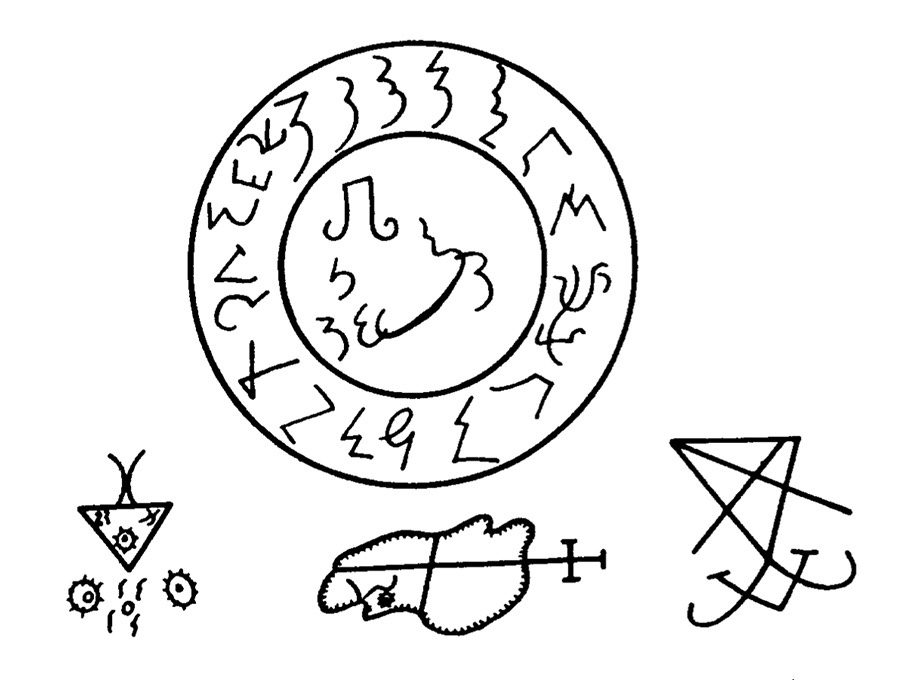
The first and main seal, the crown or circle seal, contains true names of Lucifer. Each of the 23 characters (19 around and 4 encircled) are sigils representing deific masks and forms that Lucifer takes on, and also a representation of the aspects of the mind in relation to the Daemon (True Will) or Psyche of the magician. Lucifer is indeed a composite character, holding the attributes of many previous historic gods from many different ancient civilizations and their cultural interpretations prior to the Roman Empire’s acceptance of Judeo-Christianity, a line initiated in Inana, as described above.
The second sigil, to the left, represents the five senses used in desire and focus. It is through the five senses that we can communicate and interact with the material world. It represents the materialization and manifestation of Lucifer and his will, either through himself or through the adept in the ritual. The elements are the experiences of the world around us: earth, water, air, fire, and aether. They are connected to the cycles of life in the seasons, day, and moon. The two crescent symbols at the top are the half moons of the goddess Hecate, known for her terrifying powers in the ancient world. She was honored in Asia Minor as Hecate Phosphorus, a syncretic assimilation of Hecate as the Torch Bearer. Hecate represents the moon in its three forms: maiden, mother, and crone, as well as the daemonic feminine that holds transformation. She is the goddess of the dark moon, the hidden and mysterious aspects of the mind.
The third seal contains an inverse triangle, representing the descending angels/spirits into the daemon and/or into the spirit of the magician. In the center of the triangle is the inverse eye of providence, the all-seeing eye of Lucifer, who sees all and also through which his light, wisdom, and knowledge may be conveyed. The two other eyes below are the eyes from the skull of the adept, the mask of the flesh in this world. The circle in the center is the circle of self, the evocation center in ceremonial workings used in rituals and meditations as a reminder to shape your world to your design and to act as a shock of going out of the comfort zone to test your strength continually. This is the sigil that is directly related to the use of the other three. It is the shade or shadow of the adept. The astral shadow is the vehicle of initiation on the subconscious level, and you may shape it into any form you wish. The eye is the floating watcher, the tendril emerging.
The fourth and last seal resembles a chalice, representing creation, the fertile darkness awaiting and ready for untold possibilities. This sigil is believed to have most likely derived from a magick square, the origins of which are now lost. This likely explains its use and popularity over the first sigils. The “X” over the sigil symbolizes the power and realm of the physical plane, the passion and sensuality that drives all entities. The “V” at the bottom of the sigil represents the duality of all things: dark and light, male and female, and the power of convergence of the two into one manifesting balance, creation, and existence. Lucifer is the morning and evening star, the balance between our higher consciousness and primal instinct. As Venus is both the planet of love and war, Luciferians recognize the creative and destructive aspects of ourselves. We don’t deny it, we seek to balance these aspects. I personally see this last sigil as a summary of the idea of the Light-Bearer and its inherent duality.
 Lux Satana